
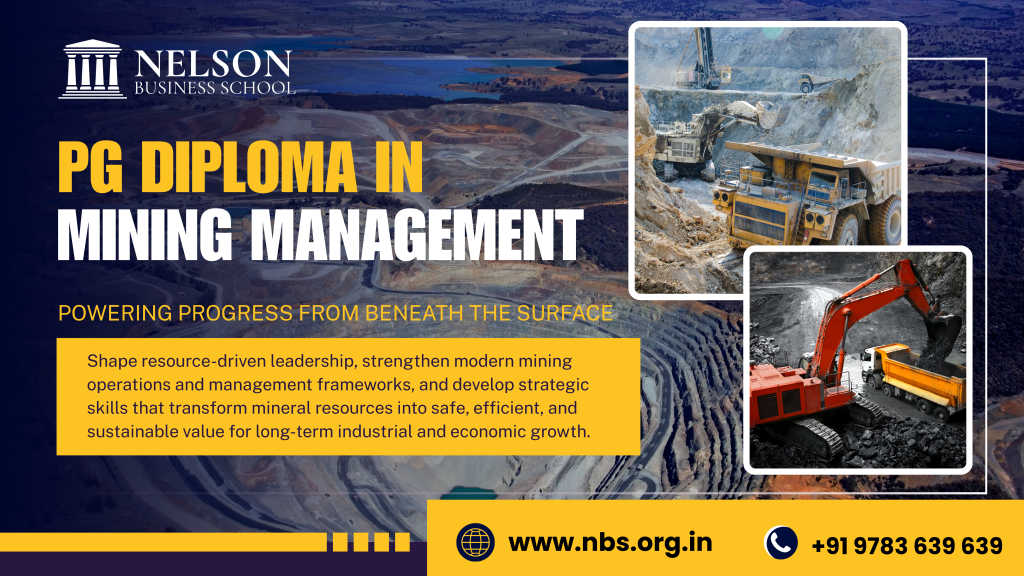
PG Diploma in Mining Management: An Academic Perspective on Resource and Operations Leadership
Introduction
Mining remains a foundational industry that supports global economic development by supplying critical raw materials necessary for infrastructure development, energy generation, manufacturing, and technological advancement. As the industry evolves, mining operations are increasingly influenced by technological innovation, stringent safety standards, environmental sustainability requirements, and regulatory frameworks. These changes demand professionals who possess not only technical mining knowledge but also advanced management and leadership capabilities.
The Post Graduate Diploma in Mining Management (PGDMM) is an advanced academic program designed to develop professionals with interdisciplinary expertise in mining engineering principles, management science, environmental governance, safety systems, and organizational leadership. The program addresses the growing need for trained managers capable of overseeing complex mining operations while ensuring economic efficiency, regulatory compliance, and sustainable resource utilization.
Program Overview
The PG Diploma in Mining Management is a specialized postgraduate qualification that integrates core mining concepts with contemporary management practices. The curriculum emphasizes analytical reasoning, strategic planning, operational control, and ethical decision-making within mining enterprises.
This program is structured to provide both theoretical foundations and applied knowledge, enabling learners to understand the entire mining value chain—from exploration and extraction to processing, logistics, and mine closure planning.
Aims and Objectives of the Program
The academic objectives of the PG Diploma in Mining Management include:
To develop a comprehensive understanding of mining systems and operational methodologies
To impart managerial competencies required for planning, organizing, and controlling mining activities
To analyze mining economics and financial decision-making processes
To ensure familiarity with national and international mining laws, safety standards, and environmental regulations
To promote sustainable and responsible mining practices
To enhance leadership, communication, and workforce management skills
To prepare professionals for supervisory, administrative, and strategic roles in mining organizations
Program Structure and Curriculum Framework
The curriculum is designed using an interdisciplinary approach, combining mining technology with business and management studies.
Core Academic Areas
Mining Operations and Technology
Principles of surface and underground mining
Mining methods and equipment management
Mine design, planning, and production scheduling
Safety, Health, and Risk Management
Occupational health and safety in mining
Hazard identification and risk assessment
Disaster management and emergency preparedness in mines
Environmental Management and Sustainability
Environmental impact assessment (EIA)
Sustainable mining practices
Waste management and mine reclamation
Climate and ecological considerations in mining
Mining Laws and Regulatory Framework
National mining policies and legislation
Labor laws and industrial relations in mining
Compliance, inspections, and ethical governance
Mining Economics and Financial Management
Cost estimation and budgeting in mining projects
Mineral economics and valuation
Investment appraisal and financial risk management
Human Resource and Organizational Management
Workforce planning and labor productivity
Industrial relations and labor welfare
Leadership and organizational behavior in mining environments
Supply Chain and Logistics Management
Material handling and transportation systems
Inventory control and procurement
Logistics optimization in mining operations
Teaching and Learning Methodology
The program adopts a learner-centric academic approach, incorporating:
Lectures and case-based learning
Industry-oriented assignments
Practical problem-solving exercises
Project work and operational analysis
Real-world mining case studies
Self-directed learning and academic research
This methodology ensures that learners develop both conceptual understanding and practical problem-solving abilities relevant to mining management.
Eligibility Criteria
A bachelor’s degree in any discipline from a recognized institution
Suitable for graduates in engineering, science, commerce, or management
Designed for both fresh graduates and working professionals
Career Pathways and Professional Outcomes
Graduates of the PG Diploma in Mining Management are prepared for mid-level and senior-level roles, including:
Mining Operations Manager
Mine Superintendent
Safety and Risk Management Officer
Production and Planning Manager
Environmental Compliance Manager
Mining Project Manager
Quality and Productivity Analyst
Mining and Resource Management Consultant
Industry Applications
Graduates can find opportunities in:
Public and private mining companies
Mineral processing and extraction firms
Energy, coal, and metal industries
Infrastructure and construction organizations
Government mining and regulatory departments
Environmental and safety consultancy agencies
Mining technology and equipment manufacturers
Skills and Competencies Developed
Upon completion, learners gain:
Advanced operational and managerial competence
Strategic planning and analytical thinking abilities
Knowledge of safety systems and compliance frameworks
Environmental and sustainability management expertise
Leadership and team management skills
Ethical decision-making and governance understanding
Relevance and Future Scope
The global mining industry is undergoing transformation driven by automation, digital technologies, sustainability imperatives, and regulatory reforms. Professionals with specialized qualifications in mining management are essential to lead this transition.
The PG Diploma in Mining Management prepares graduates to meet these evolving demands, making it a valuable academic and professional qualification with long-term relevance.
Conclusion
The PG Diploma in Mining Management represents a rigorous academic program that equips learners with integrated knowledge of mining operations and management science. By emphasizing safety, sustainability, economic efficiency, and ethical governance, the program prepares graduates to assume leadership roles in one of the world’s most critical industries.
For individuals seeking a structured academic pathway into mining leadership and management, this diploma provides a strong foundation for career advancement and professional excellence.