
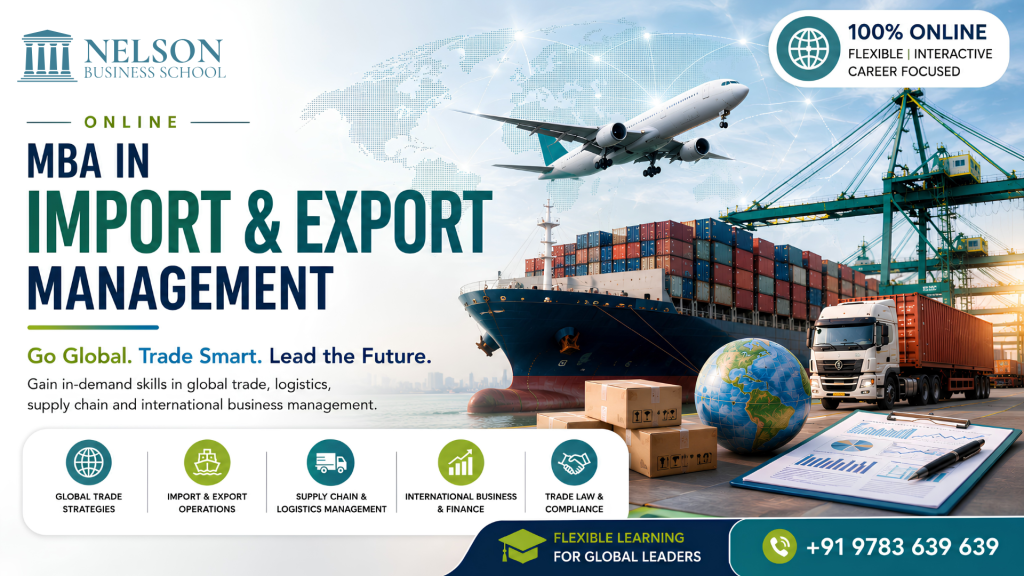
How Online MBA in Import and Export Management Prepares You for Global Trade
Introduction
Global trade is the backbone of the modern economy — connecting manufacturers, suppliers, and markets across borders. As businesses increasingly expand into international markets, they need professionals who understand the complexities of cross-border trade: customs regulations, international logistics, trade finance, and global market strategy.
An Online MBA in Import and Export Management is specifically designed to build this expertise, combining core business management education with specialized international trade knowledge — all through a flexible, online format that fits around working professionals’ schedules. This blog explores exactly how this program prepares graduates for real careers in global trade.
What Is an Online MBA in Import and Export Management?
This is a specialized postgraduate program that trains professionals in the strategic, operational, and regulatory aspects of international trade. Delivered through virtual classrooms and digital learning platforms, it typically covers:
- 1. International trade policies and regulations
- 2. Export-import documentation and customs procedures
- 3. Global logistics and supply chain management
- 4. International trade finance and foreign exchange
- 5. Global market entry strategies
- 6. Trade compliance and risk management
Unlike a general MBA, this program focuses specifically on the skills needed to navigate cross-border business — making graduates job-ready for roles in international trade from day one.
Why Global Trade Careers Require Specialized Training
International trade is inherently complex, involving multiple countries’ regulations, currencies, and logistics networks. Professionals working in this space need to understand:
- 1. Customs procedures and documentation requirements across different countries
- 2. International trade agreements and their impact on business
- 3. Currency fluctuations and their effect on trade transactions
- 4. Global supply chain coordination and logistics challenges
- 5. Risk factors unique to cross-border transactions, such as political and currency risk
A general business degree often doesn’t provide this depth of specialized knowledge — which is where an MBA in Import and Export Management becomes particularly valuable.
How an Online MBA in Import and Export Management Builds Global Trade Readiness
1. Deep Understanding of Trade Regulations and Compliance
Students learn the regulatory frameworks governing international trade — including export-import policies, customs procedures, and compliance requirements — reducing the learning curve when handling real cross-border transactions on the job.
2. Documentation and Procedural Expertise
Import-export business relies heavily on accurate documentation — bills of lading, letters of credit, certificates of origin, and customs declarations. Specialized coursework builds practical familiarity with these critical documents and processes.
3. International Logistics and Supply Chain Knowledge
Understanding how goods move across borders — including freight forwarding, shipping methods, and warehousing — is central to the curriculum, preparing graduates to manage or coordinate global supply chains effectively.
4. Trade Finance and Foreign Exchange Skills
Global trade involves unique financial instruments like letters of credit, trade credit insurance, and foreign exchange risk management. MBA coursework builds practical knowledge of these tools, essential for managing international transactions.
5. Global Market Entry Strategy
Beyond operational knowledge, students learn how businesses evaluate and enter new international markets — covering market research, cultural considerations, and strategic positioning for global expansion.
6. Risk Management in Cross-Border Trade
Political instability, currency fluctuations, and regulatory changes all pose risks to international trade. Coursework in risk assessment and mitigation prepares graduates to anticipate and manage these challenges.
7. Real-World Case Studies and Global Business Simulations
Many programs incorporate case studies based on real international trade scenarios, helping students understand how global businesses navigate cross-border challenges in practice.
Program Structure for Working Professionals
| Feature | How It Supports Working Professionals |
|---|---|
| Recorded Lectures | Study at your own pace, outside work hours |
| Live Weekend/Evening Sessions | Attend interactive classes without conflicting with work schedules |
| Flexible Assignment Deadlines | Manage coursework around work commitments |
| Digital Learning Platforms | Access study material and resources anytime, from anywhere |
| Virtual Peer Networks | Connect with professionals from diverse trade and business backgrounds |
Core Curriculum Areas
| Module | Key Focus Areas |
|---|---|
| International Trade Fundamentals | Trade theories, global economic environment |
| Export-Import Documentation | Customs procedures, shipping documents, compliance |
| Global Logistics & Supply Chain | Freight forwarding, warehousing, international shipping |
| Trade Finance & Forex | Letters of credit, trade credit, currency risk management |
| International Marketing | Global market entry, cross-cultural business strategy |
| Trade Law & Compliance | International trade agreements, regulatory frameworks |
| Risk Management | Political, currency, and operational risk in global trade |
| Capstone Project | Applied international trade case study or business project |
Career Opportunities After Online MBA in Import and Export Management
Graduates can pursue roles such as:
- 1. Import-Export Manager
- 2. International Trade Analyst
- 3. Global Logistics/Supply Chain Manager
- 4. Trade Finance Executive
- 5. Customs and Compliance Manager
- 6. International Business Development Manager
- 7. Freight Forwarding Manager
Industries and Employers Hiring Global Trade Professionals
- 1. Import-export trading companies
- 2. Manufacturing companies with global supply chains
- 3. Freight forwarding and logistics firms
- 4. International banking and trade finance institutions
- 5. E-commerce companies with cross-border operations
- 6. Government trade promotion bodies and export councils
Salary Growth Potential
Professionals with an MBA in Import and Export Management can see strong career growth, with mid-level roles in international trade and logistics typically earning in the range of ₹7–14 LPA, and senior roles in global trade strategy or supply chain leadership commanding significantly more depending on industry and company scale.
How This MBA Helps While You Continue Working
1. Immediate Application to Current Trade-Related Work
Professionals already working in logistics, procurement, or business development can directly apply concepts like documentation processes or trade finance tools to their current roles.
2. Stronger Case for International Role Transitions
Formal credentials in import-export management can strengthen your position when seeking transitions into global trade, international business development, or supply chain leadership roles.
3. Builds Cross-Border Business Confidence
Even professionals not directly working in trade roles benefit from understanding global business operations — valuable knowledge as more companies expand internationally.
4. Expands Career Mobility Across Industries
Import-export management skills are highly transferable across manufacturing, logistics, e-commerce, and trade finance sectors, offering flexibility in career direction.
Online MBA in Import-Export vs. Regular MBA in International Business
| Factor | Online MBA in Import-Export | Regular MBA |
|---|---|---|
| Format | Virtual classes, flexible scheduling | In-person, fixed schedule |
| Focus | Specialized global trade skills | Broader general management training |
| Cost | Generally more affordable | Higher due to campus costs |
| Best For | Working professionals in or entering trade roles | Full-time students seeking broad management exposure |
| Career Application | Directly applicable to import-export roles | General business roles across industries |
For professionals specifically targeting careers in international trade, logistics, or global business development, the specialized online format often provides more directly relevant, practical skills.
Tips for Success While Studying
- 1. Apply trade concepts to current work tasks whenever possible, even in adjacent roles like procurement or logistics
- 2. Stay updated on current global trade news — tariffs, trade agreements, and policy changes — to contextualize coursework
- 3. Engage with virtual peer networks to build connections across different trade sectors and countries
- 4. Use case studies to build a portfolio of applied knowledge you can reference in job interviews
- 5. Balance coursework with realistic milestones to avoid last-minute pressure around exams or projects
Frequently Asked Questions (FAQs)
Q1. Is this MBA useful if I have no prior experience in international trade? Yes. The program is designed to build foundational and advanced knowledge from the ground up, making it accessible to professionals transitioning into global trade from other business functions.
Q2. Can I pursue this MBA while working in a non-trade role? Absolutely. Many professionals use this program to build credible expertise before transitioning into international trade, logistics, or global business roles.
Q3. What industries hire graduates of this program? Import-export trading companies, manufacturing firms with global supply chains, logistics and freight forwarding companies, trade finance institutions, and international e-commerce businesses are among the top employers.
Q4. Does this program cover trade regulations for multiple countries? Most programs cover general international trade frameworks and major trade agreements, along with country-specific customs and compliance principles, though depth may vary by institute — it’s worth checking specific curriculum details.
Q5. How long does this online MBA typically take to complete? Most programs are designed to be completed in about 2 years, though this can vary depending on the institute and course structure.
Conclusion
As businesses continue expanding across borders, the demand for professionals who understand the complexities of global trade continues to grow. An Online MBA in Import and Export Management equips graduates with the regulatory knowledge, logistics expertise, and strategic thinking needed to succeed in international trade — all while allowing working professionals to build these skills without pausing their careers.
Ready to build a career in global trade? Explore Online MBA in Import and Export Management programs designed to prepare you for real, in-demand roles in international business, logistics, and trade finance.

Our courses equip students with the skills to excel as managers, enhancing productivity, strategic thinking, and policy formulation for organizational success.
Contact Info
- +91 9783 639 639
- enquiry@nbs.org.in
- Nelson Business School 2nd Floor, EAPL Ascent, No. 6-3-252/3, Above HDFC Bank, Opp: Taj Deccan, Erramanzil, Banjara Hills Main Road, Hyderabad, Telangana - 500082.
© 2026 Nelson B-School All Rights Reserved.