
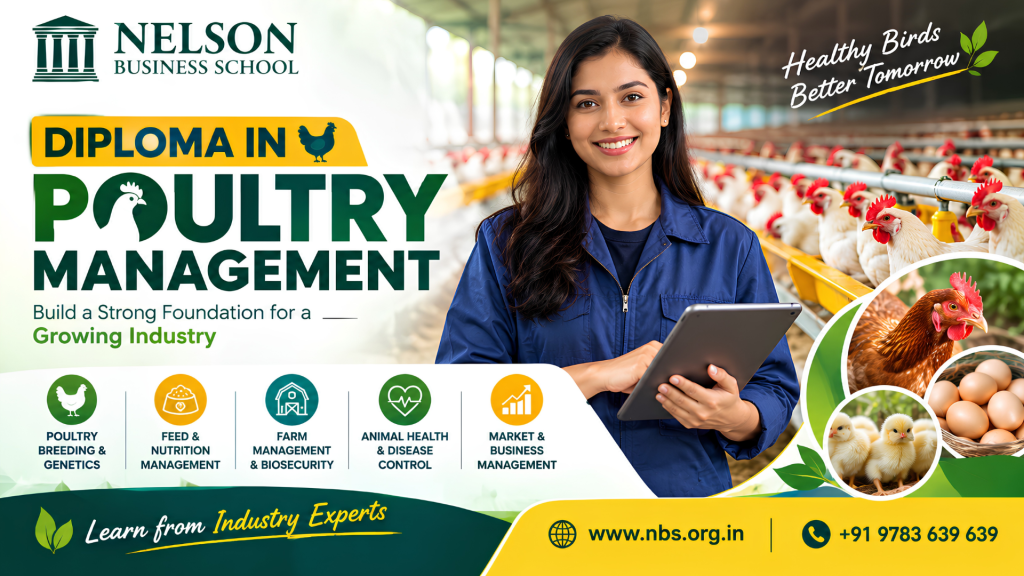
Online Diploma in Poultry Management: Start Your Own Poultry Business
Introduction
Poultry farming remains one of the most accessible and steadily growing agribusiness sectors — driven by consistent demand for eggs and poultry meat, relatively lower entry barriers compared to other livestock businesses, and increasing interest in structured, scientific farming practices. But turning poultry farming into a genuinely profitable business requires more than raising birds — it demands knowledge of breed selection, disease management, feed economics, market access, and financial planning.
An Online Diploma in Poultry Management is designed to build exactly this combination of technical and business knowledge. This blog explores how the program equips aspiring entrepreneurs with the practical skills needed to plan, launch, and grow a poultry business — all through a flexible, online format.
What Is an Online Diploma in Poultry Management?
This is a specialized program that combines poultry farming science with practical business management skills, delivered through virtual classrooms and digital learning platforms. Core areas typically include:
- 1. Poultry breeds and selection
- 2. Poultry housing and farm setup
- 3. Nutrition and feed management
- 4. Disease prevention and health management
- 5. Hatchery management
- 6. Poultry farm business planning and finance
- 7. Marketing and supply chain for poultry products
Why Poultry Farming Is an Attractive Business Opportunity
1. Consistent Market Demand
Eggs and poultry meat remain staple food items with steady, year-round demand, providing a relatively stable market base compared to more seasonal agricultural products.
2. Relatively Lower Entry Barriers
Compared to many other livestock or agricultural businesses, poultry farming can often be started with a comparatively modest initial setup, especially at smaller scales, making it accessible to first-time entrepreneurs.
3. Faster Production Cycles
Poultry — particularly broiler chickens — have relatively short production cycles compared to many other livestock businesses, allowing for quicker returns and faster reinvestment cycles.
4. Growing Demand for Scientific Farming Practices
As the poultry industry professionalizes, farms using scientific, well-managed practices tend to see better productivity and fewer losses — creating a real advantage for entrepreneurs with formal training.
5. Diverse Business Models
Poultry farming offers multiple business paths — egg production (layer farming), meat production (broiler farming), hatchery operations, or even value-added products — allowing entrepreneurs to choose a model that fits their resources and goals.
How This Diploma Builds Business-Ready Poultry Entrepreneurs
1. Scientific Farm Setup Knowledge
Understanding proper housing design, ventilation, and space requirements helps new entrepreneurs avoid costly setup mistakes and build farms that support healthy, productive birds from the start.
2. Breed Selection for Business Goals
Coursework on poultry breeds helps entrepreneurs choose the right breed for their specific business model — whether focused on egg production, meat production, or a combination — directly impacting profitability.
3. Feed and Nutrition Cost Management
Since feed typically represents one of the largest ongoing costs in poultry farming, training in nutrition and feed management helps entrepreneurs optimize feed efficiency and control this major expense.
4. Disease Prevention and Risk Reduction
Disease outbreaks can devastate a poultry business financially. Training in health management and biosecurity practices helps entrepreneurs reduce this significant business risk.
5. Business and Financial Planning Skills
Beyond farming technique, coursework in business planning helps entrepreneurs think through startup costs, cash flow, break-even analysis, and growth planning — essential for building a sustainable business, not just a farming operation.
6. Market Access and Supply Chain Understanding
Understanding how poultry products move to market — including relationships with distributors, retailers, or direct sales channels — helps entrepreneurs plan realistic sales strategies from the outset.
7. Hatchery Operations Knowledge
For those interested in expanding into hatchery operations, coursework provides foundational knowledge for this higher-value segment of the poultry business.
Core Curriculum Areas
| Module | Key Focus Areas |
|---|---|
| Poultry Breeds & Selection | Layer, broiler, and dual-purpose breed characteristics |
| Farm Setup & Housing | Housing design, ventilation, space planning |
| Nutrition & Feed Management | Feed formulation, cost-efficient feeding practices |
| Disease Management & Biosecurity | Common diseases, prevention, vaccination schedules |
| Hatchery Management | Incubation processes, hatchery operations |
| Business Planning & Finance | Startup costs, budgeting, break-even analysis |
| Marketing & Supply Chain | Distribution channels, market access strategies |
| Capstone Project | Applied poultry business plan development |
Building Your Poultry Business: Key Considerations Covered in the Program
1. Choosing Your Business Model
The program helps aspiring entrepreneurs evaluate different poultry business models — layer farming (eggs), broiler farming (meat), or hatchery operations — based on their available resources, local market demand, and personal goals.
2. Understanding Startup Requirements
Coursework typically covers the practical realities of setting up a poultry farm, including land, housing, equipment, and initial livestock investment considerations, helping entrepreneurs plan more realistically.
3. Managing Ongoing Operational Costs
Since feed, healthcare, and labor represent significant ongoing costs, the program builds skills in tracking and managing these expenses to maintain healthy profit margins.
4. Planning for Market Access
Understanding local and regional market dynamics — including pricing trends and buyer relationships — helps entrepreneurs plan realistic sales strategies rather than assuming demand will simply appear.
5. Risk Management Planning
Given the vulnerability of poultry farming to disease outbreaks and market price fluctuations, the program emphasizes building risk management practices into business planning from the start.
Career and Business Opportunities After Online Diploma in Poultry Management
Graduates can pursue paths such as:
- 1. Independent Poultry Farm Owner (layer, broiler, or mixed operations)
- 2. Poultry Hatchery Operator
- 3. Poultry Farm Manager (for existing commercial operations)
- 4. Poultry Feed and Supply Business
- 5. Poultry Consultant/Advisor
- 6. Agribusiness Development Roles (with poultry companies or cooperatives)
Potential Business Growth Paths
- 1. Starting with small-scale layer or broiler farming
- 2. Expanding into hatchery operations for higher value-add
- 3. Developing direct-to-consumer or retail supply relationships
- 4. Diversifying into value-added products (processed or packaged poultry items)
Financial Considerations
Profitability in poultry farming depends heavily on factors like scale, local market prices, feed costs, and disease management effectiveness — there’s no guaranteed fixed return, and outcomes vary significantly by region and business execution. The diploma’s focus on cost management, disease prevention, and business planning is specifically designed to help entrepreneurs improve their odds of running a sustainable, profitable operation, though individual results will depend on many variables including local conditions and market access.
Online Diploma vs. B.Sc. in Poultry Science
| Factor | Online Diploma in Poultry Management | B.Sc. in Poultry Science |
|---|---|---|
| Duration | Typically 6-12 months | 3-4 years |
| Focus | Applied, business-oriented poultry farming skills | Deeper scientific and research-based training |
| Cost | Generally more affordable | Higher investment |
| Best For | Aspiring entrepreneurs, quick practical entry | Research, technical, or academic poultry science careers |
| Format | Online, flexible scheduling | Typically full-time, on-campus |
For those specifically interested in starting a poultry business relatively quickly, the diploma’s practical, business-oriented approach is often more directly useful than a longer academic science degree.
Tips for Turning This Diploma into a Successful Poultry Business
- 1. Start small and scale gradually, applying lessons learned before expanding operations significantly
- 2. Prioritize disease prevention and biosecurity from day one — it’s often more cost-effective than treating outbreaks after they occur
- 3. Build relationships with local buyers or distributors early, rather than assuming demand will materialize automatically
- 4. Track your costs meticulously, particularly feed expenses, to maintain healthy margins
- 5. Stay connected with other poultry entrepreneurs through the program’s peer network for ongoing knowledge sharing
- 6. Research local government schemes or subsidies that may support new agribusiness ventures in your region
Frequently Asked Questions (FAQs)
Q1. Do I need prior farming experience to pursue this diploma? No, most programs are designed for beginners, including those with no prior farming background, building foundational knowledge progressively.
Q2. Is poultry farming a profitable business? Profitability depends on many factors, including scale, local market conditions, management practices, and disease control. While poultry farming can be a viable business, it’s not without risk, and success depends significantly on how well the operation is planned and managed — which is exactly what this diploma aims to help with.
Q3. How much capital do I need to start a poultry business? Startup costs vary widely based on scale, location, and business model (layer vs. broiler vs. hatchery). It’s advisable to research local costs and consult with agricultural extension services or financial advisors for a realistic assessment specific to your situation.
Q4. Can I really learn poultry farming skills online? Yes, foundational knowledge in breeds, nutrition, disease management, and business planning can be effectively taught online, though many aspiring entrepreneurs benefit from supplementing this with hands-on visits to existing poultry farms.
Q5. What government support is available for poultry farming businesses? Many regions offer agricultural subsidies, loans, or support schemes for poultry and livestock businesses — it’s worth researching programs specific to your state or country, as these vary significantly by location.
Conclusion
Building a profitable poultry business requires more than enthusiasm — it demands practical knowledge of farming science, disease management, and sound business planning. An Online Diploma in Poultry Management is specifically designed to build this combination of skills, helping aspiring entrepreneurs approach poultry farming as a well-planned business rather than a trial-and-error venture.
Ready to start planning your poultry business? Explore Online Diploma in Poultry Management programs designed to equip you with the practical farming and business skills needed to build a sustainable poultry enterprise.
Note: This content is for informational purposes only and does not constitute financial or business investment advice. Prospective entrepreneurs should conduct their own market research and consult relevant financial or agricultural advisors before making business decisions.