
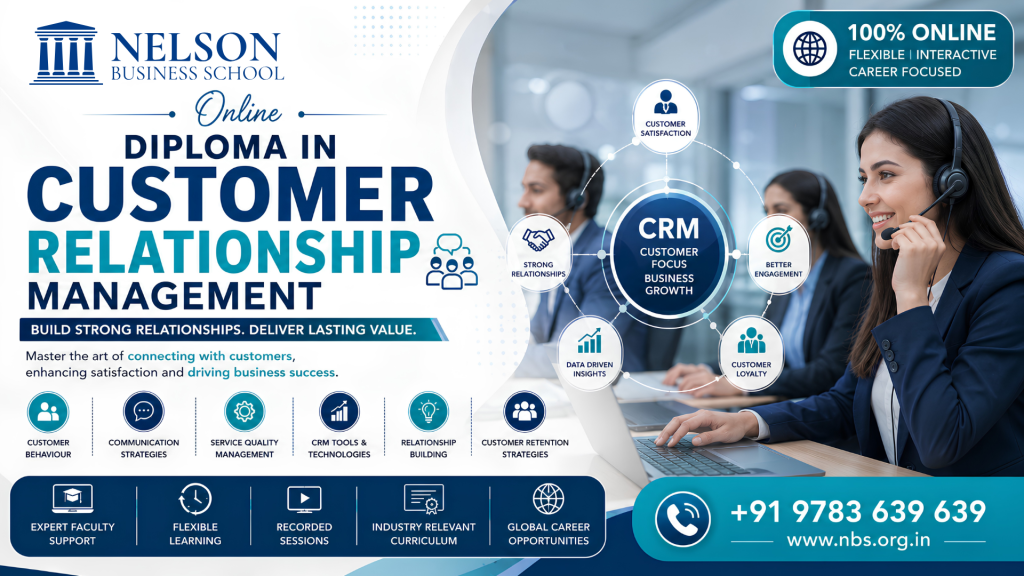
Online Diploma in Customer Relationship Management: A Growing Career Path in the Digital Economy
Introduction
In today’s digital economy, businesses no longer compete on product alone — they compete on customer experience. From personalized marketing to responsive customer support, companies that manage customer relationships well consistently outperform those that don’t. At the center of this shift is Customer Relationship Management (CRM) — both as a business philosophy and as a rapidly growing career field.
As businesses across industries invest heavily in CRM platforms, data-driven customer engagement, and retention strategies, the demand for professionals skilled in CRM continues to rise. An Online Diploma in Customer Relationship Management offers a flexible, accessible way to build these in-demand skills — without needing to pause your current job or relocate. This blog explores why CRM has become such a strong career path and how this diploma prepares you for it.
What Is Customer Relationship Management (CRM)?
CRM refers to the strategies, processes, and technologies businesses use to manage interactions with current and potential customers throughout their entire journey — from initial contact to post-sale support. It combines:
- 1. Customer data management and analysis
- 2. Sales pipeline and lead management
- 3. Customer service and support processes
- 4. Marketing automation and personalization
- 5. Customer retention and loyalty strategies
CRM isn’t just a software category (like Salesforce or HubSpot) — it’s a business-wide approach to building long-term, profitable customer relationships.
Why CRM Careers Are Growing in the Digital Economy
1. Businesses Are Becoming More Customer-Centric
As markets grow more competitive, companies increasingly differentiate themselves through customer experience rather than price or product alone — making CRM skills essential across sales, marketing, and support functions.
2. Rapid Growth of CRM Software Adoption
Businesses of all sizes — from startups to large enterprises — are adopting CRM platforms to manage customer data and interactions, creating consistent demand for professionals who can operate and optimize these systems.
3. Data-Driven Customer Engagement
Modern CRM relies heavily on customer data analysis to personalize marketing, predict customer needs, and improve retention — requiring professionals who understand both the technology and the strategy behind it.
4. Cross-Industry Demand
Unlike some specialized skills tied to a single sector, CRM expertise is valuable across industries — retail, banking, healthcare, technology, real estate, and more — offering strong career flexibility.
5. Growth of E-commerce and Digital-First Businesses
As more businesses operate primarily online, managing customer relationships digitally — through CRM systems, chatbots, and automated engagement — has become a core operational necessity, not just a nice-to-have.
What Is an Online Diploma in Customer Relationship Management?
This is a specialized program designed to build both strategic and technical CRM skills, delivered through virtual classrooms and digital learning platforms. Core areas typically include:
- 1. CRM fundamentals and customer lifecycle management
- 2. CRM software tools (Salesforce, HubSpot, Zoho, or similar platforms)
- 3. Sales pipeline and lead management
- 4. Customer data analysis and segmentation
- 5. Customer service and support best practices
- 6. Marketing automation and personalization strategies
- 7. Customer retention and loyalty program design
How This Diploma Builds a Strong CRM Career Foundation
1. Hands-On CRM Software Training
Programs typically include practical training on widely used CRM platforms, giving students direct, job-relevant experience with the tools employers actually use.
2. Understanding the Full Customer Lifecycle
Students learn to manage customer relationships across the entire journey — from lead generation and conversion to onboarding, support, and retention — building a comprehensive view of CRM strategy.
3. Data Analysis and Customer Segmentation Skills
Coursework in customer data analysis teaches students how to segment audiences and personalize engagement strategies — a core skill in modern, data-driven CRM practices.
4. Sales and Pipeline Management Knowledge
Understanding how to manage sales pipelines within CRM systems prepares graduates for roles that bridge sales and customer relationship functions.
5. Customer Service Excellence
Modules on customer service best practices build the interpersonal and process skills needed for roles focused on customer support and satisfaction.
6. Marketing Automation Basics
As CRM increasingly integrates with marketing automation, students gain exposure to email campaigns, lead nurturing, and automated customer engagement workflows.
Program Structure for Working Professionals
| Feature | How It Supports Working Professionals |
|---|---|
| Recorded Lectures | Study at your own pace, outside work hours |
| Live Weekend/Evening Sessions | Attend interactive classes without conflicting with work schedules |
| Flexible Assignment Deadlines | Manage coursework around work commitments |
| Digital Learning Platforms | Access study material and resources anytime, from anywhere |
| Virtual Peer Networks | Connect with professionals across sales, marketing, and support functions |
Curriculum Overview
Module 1: CRM Fundamentals
- Customer lifecycle and relationship management principles
- CRM strategy and business alignment
Module 2: CRM Software Tools
- Hands-on training with platforms like Salesforce, HubSpot, or Zoho
- CRM system configuration and data management
Module 3: Sales Pipeline Management
- Lead tracking and conversion strategies
- Sales forecasting within CRM systems
Module 4: Customer Data Analysis
- Customer segmentation techniques
- Using data to personalize engagement
Module 5: Customer Service and Support
- Handling customer queries and complaints
- Building customer satisfaction and loyalty
Module 6: Marketing Automation
- Email marketing and automated workflows
- Lead nurturing strategies
Module 7: Capstone Project
- Applied CRM strategy project or case study
Career Opportunities After Online Diploma in CRM
Graduates can pursue roles such as:
- 1. CRM Executive/Analyst
- 2. Customer Relationship Manager
- 3. Sales Operations Associate
- 4. Customer Success Manager
- 5. CRM Software Administrator
- 6. Marketing Automation Specialist
- 7. Customer Experience Coordinator
Industries Hiring CRM Professionals
- E-commerce and retail
- Banking, financial services, and insurance (BFSI)
- Real estate
- SaaS and technology companies
- Healthcare and hospitality
- Telecommunications
Salary Expectations
Entry-level roles for Online Diploma in CRM graduates typically range from ₹3–6 LPA, with growth potential as professionals gain experience or specialize in CRM platform administration, customer success leadership, or marketing automation.
Online Diploma in CRM vs. Certification Courses
| Factor | Online Diploma in CRM | Standalone Certification Course |
|---|---|---|
| Depth | Comprehensive — strategy, tools, and data analysis | Often narrower, tool-specific focus |
| Duration | Typically 6-12 months | Often a few weeks |
| Cost | Moderate investment | Generally lower cost |
| Best For | Building a well-rounded CRM career foundation | Quickly upskilling in a specific tool |
| Career Impact | Broader career readiness across CRM functions | Useful as a supplementary or focused credential |
A diploma often provides a stronger, more comprehensive foundation for those serious about building a long-term CRM career, while certifications can be useful as focused, supplementary credentials.
Why CRM Is a Smart Career Choice in the Digital Economy
- 1. High cross-industry demand — CRM skills transfer across nearly every sector
- 2. Growing reliance on CRM technology — businesses continue investing in CRM platforms
- 3. Blend of technical and interpersonal skills — valuable in both tech-driven and people-facing roles
- 4. Clear career progression — from CRM executive roles to customer success or CRM strategy leadership
- 5. Remote-work compatibility — many CRM roles offer flexible or remote work arrangements, aligning well with digital economy trends
Frequently Asked Questions (FAQs)
Q1. Is CRM a good career choice in 2026? Yes. As businesses continue prioritizing customer experience and data-driven engagement, CRM skills remain in strong, cross-industry demand.
Q2. Do I need a technical background to pursue this diploma? No, most programs are designed for beginners and don’t require a technical background, though basic computer literacy is helpful.
Q3. What CRM tools will I learn in this program? Most programs include training on widely used platforms like Salesforce, HubSpot, or Zoho, depending on the institute’s curriculum.
Q4. Can this diploma lead to remote work opportunities? Yes, many CRM-related roles, especially in customer success and CRM administration, offer remote or hybrid work options, particularly in tech and SaaS companies.
Q5. What is the difference between CRM and general sales or marketing roles? CRM roles specifically focus on managing customer data, relationships, and engagement strategies across the customer lifecycle, whereas general sales or marketing roles may focus more narrowly on acquisition or specific campaign execution.
Conclusion
As the digital economy continues to prioritize customer experience and data-driven engagement, Customer Relationship Management has emerged as a genuinely valuable and growing career path. An Online Diploma in Customer Relationship Management offers a flexible, practical way to build the strategic thinking, technical tool proficiency, and customer-facing skills needed to succeed — all while fitting around your current commitments.
Ready to build a career at the intersection of customers, data, and technology? Explore Online Diploma in Customer Relationship Management programs designed to prepare you for in-demand roles across sales, marketing, and customer success.

Our courses equip students with the skills to excel as managers, enhancing productivity, strategic thinking, and policy formulation for organizational success.
Contact Info
- +91 9783 639 639
- enquiry@nbs.org.in
- Nelson Business School 2nd Floor, EAPL Ascent, No. 6-3-252/3, Above HDFC Bank, Opp: Taj Deccan, Erramanzil, Banjara Hills Main Road, Hyderabad, Telangana - 500082.
© 2026 Nelson B-School All Rights Reserved.