
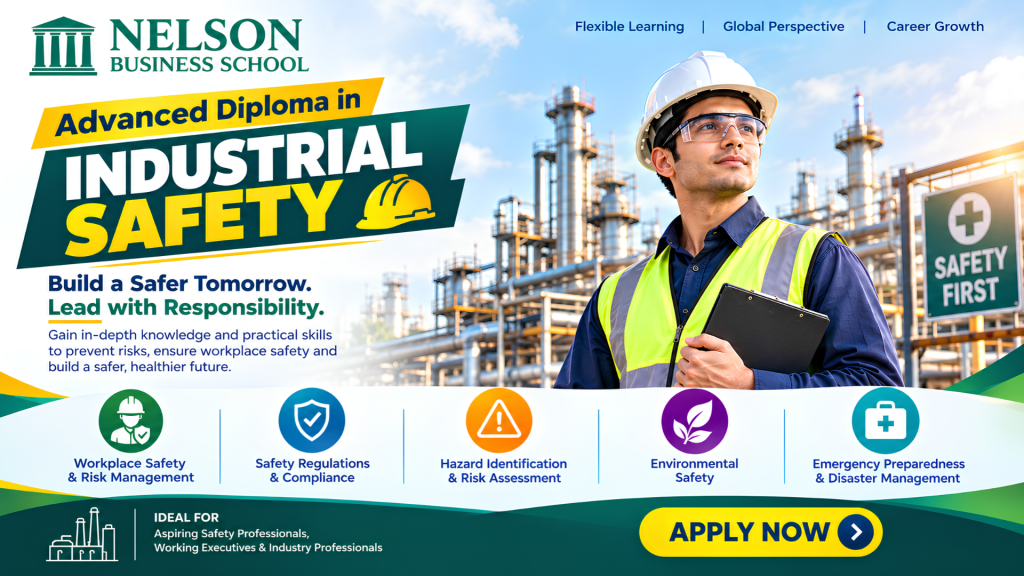
Best Online Advanced Diploma in Industrial Safety
Introduction
Every factory floor, construction site, refinery, warehouse, and power plant carries risk. Moving machinery, hazardous chemicals, heights, confined spaces, electrical systems, and fire are part of daily industrial life. Behind every plant that runs safely is a team of people who identify hazards, set procedures, train workers, investigate incidents, and make sure the law is followed.
As industries grow and safety expectations rise, demand for trained safety professionals continues to be strong. An Advanced Diploma in Industrial Safety is one of the most common ways to enter or advance in this field, and online programs now make it possible to study without leaving your job.
But “best” means different things to different learners. This guide explains what an advanced diploma in industrial safety covers, what to look for when comparing programs, what an online diploma can and can’t do, and how to avoid costly mistakes, especially if your goal is a statutory safety officer role.
What Is Industrial Safety?
Industrial safety (also called occupational health and safety, or OHS) is the discipline of protecting people, property, and the environment from accidents and health hazards in industrial workplaces. It covers:
- 1. Identifying hazards and assessing risks
- 2. Preventing accidents, fires, explosions, and chemical exposures
- 3. Protecting workers’ health, including noise, dust, and ergonomics
- 4. Safe work systems, such as permits to work and lockout/tagout
- 5. preparedness and response
- 6. Incident reporting and investigation
- 7. Legal compliance and audits
- 8. Building a safety culture through training and communication
Safety is not just paperwork. It involves site-level judgment, communication, and constant attention.
What Is an Advanced Diploma in Industrial Safety?
It is a structured program that builds technical and legal knowledge for safety roles in industry. It is typically aimed at graduates, diploma holders, and working professionals such as supervisors, technicians, and engineers.
Programs commonly cover:
- 1. Fundamentals of industrial safety and health
- 2. Hazard identification and risk assessment (HIRA, JSA)
- 3. Fire prevention and protection
- 4. Chemical safety and hazardous materials
- 5. Electrical, mechanical, and process safety basics
- 6. Construction and height safety
- 7. Industrial hygiene and occupational health
- 8. Personal protective equipment (PPE)
- 9. Safety management systems and standards
- 10. Incident investigation and root cause analysis
- 11. Emergency planning and disaster preparedness
- 12. Safety laws, rules, and compliance
- 13. Safety audits and inspections
- 14. Behaviour-based safety and safety culture
- 15. Environmental, health and safety (EHS) basics
Curriculum varies by institute, so always review the syllabus before enrolling.
Why Industrial Safety Skills Are in Demand
1. Hazards Exist in Almost Every Industry
Manufacturing, construction, oil and gas, chemicals, power, mining, pharmaceuticals, logistics, and food processing all depend on safe operations.
2. Accidents Are Costly
Beyond human harm, accidents cause legal liability, production loss, reputation damage, and insurance costs. Companies invest in prevention.
3. Legal and Compliance Requirements
Industrial workplaces must follow safety laws and standards. Qualified people are needed to implement, monitor, and document compliance.
4. Client and Global Expectations
Large clients and international partners often expect formal safety systems and trained safety staff.
5. A Growing Focus on Wellbeing and Culture
Employers increasingly look beyond compliance to behaviour, training, and prevention.
Demand varies by industry, region, and time, so check the job market in your area.
How to Choose the “Best” Online Advanced Diploma in Industrial Safety
No single program is best for everyone. The right one depends on your goal, your industry, and the rules that apply to you. Use these criteria to compare options honestly.
1. Recognition and Approval
- 1. Is the institute or university properly recognised?
- 2. For online programs in India, is the specific program approved in online mode on the official UGC-DEB portal for the current session? Verify it directly, not through third-party sites.
- 3. If your goal is a statutory role, is the diploma recognised for that purpose? (See the safety officer section below.)
2. Relevance to Your Goal
- 1. If you want a statutory safety officer role, recognition under state rules matters most.
- 2. If you want to upgrade within your company, practical content and a recognised credential may be enough.
- 3. If you want international or multinational roles, check whether employers value internationally recognised safety certifications alongside or instead of a diploma.
3. Curriculum Depth and Currency
- 1. Does it cover hazard identification, risk assessment, fire safety, chemical safety, incident investigation, audits, and legal compliance in real depth?
- 2. Is the syllabus updated as laws and standards change?
4. Practical Training
Safety is a hands-on discipline. Ask:
- 1. Are there site-based assignments, workplace projects, or internships?
- 2. Are there workshops, practical demonstrations, or on-site training components?
- 3. How does the program handle skills that are hard to teach online, such as fire-fighting practice, PPE use, and site inspections?
5. Faculty Experience
Prefer instructors with real industrial safety, EHS, or plant experience, not just academic backgrounds.
6. Flexibility and Support
- 1. Live sessions and recorded lectures that suit shift work
- 2. Doubt-clearing and academic support
- 3. A realistic exam schedule
7. Transparency
- 1. Clear fees and inclusions
- 2. Written approval details
- 3. A refund policy
- 4. Honest outcome information, without guarantees
8. Alumni and Employer Feedback
Ask how past students have used the diploma, and whether employers in your industry recognise it.
Can You Become a Safety Officer With an Online Advanced Diploma?
This is the question many learners care about most, and it deserves a careful answer.
In India, the qualifications required to be appointed as a statutory safety officer under factory and related laws are set by law. They commonly involve a specified combination of education and a recognised diploma or training, and they can differ by state and industry. The legal framework has also been undergoing change as older laws are consolidated into the new Labour Codes, including the one on occupational safety, health and working conditions.
What this means for you:
- 1. A diploma builds knowledge and skills, but it may not on its own satisfy the statutory requirement for appointment as a safety officer.
- 2. Recognition matters. Some state rules specify which institutes or bodies’ diplomas are acceptable. An online diploma from a university may or may not meet them.
- 3. Rules change. Don’t rely on old information or on what an admissions counsellor says.
What to Do
- 1. Identify the state and industry where you want to work
- 2. Check the current rules with the state’s factory inspectorate or directorate of industrial safety and health, or the relevant labour authority
- 3. Ask the institute in writing whether its diploma is accepted for statutory safety officer appointment in your state
- 4. Treat any guarantee of “safety officer eligibility” with caution unless you have verified it independently
An online advanced diploma can still be valuable for non-statutory roles, upskilling, and career growth, even if it doesn’t by itself meet a statutory requirement.
Typical Curriculum Overview
| Module | Key Focus Areas |
|---|---|
| Introduction to Industrial Safety | Concepts, accident causation, safety management basics |
| Hazard Identification and Risk Assessment | HIRA, job safety analysis, risk matrices, control measures |
| Fire Safety and Prevention | Fire science, detection, protection systems, emergency response |
| Chemical and Process Safety | Hazardous materials, storage, handling, process hazards |
| Electrical and Mechanical Safety | Machine guarding, lockout/tagout, electrical hazards |
| Construction and Work at Height Safety | Scaffolding, excavation, confined spaces, permit-to-work |
| Industrial Hygiene and Occupational Health | Noise, dust, ergonomics, exposure monitoring, health surveillance |
| PPE and Safe Work Practices | Selection, use, and limitations of protective equipment |
| Incident Investigation and Reporting | Root cause analysis, corrective and preventive action |
| Safety Management Systems and Standards | Policies, procedures, audits, management system concepts |
| Safety Laws and Compliance | Relevant statutes, rules, documentation, inspections |
| Emergency Preparedness | On-site and off-site planning, drills, evacuation |
| Behaviour-Based Safety and Culture | Training, communication, leadership in safety |
| Project / Capstone | Safety audit, risk assessment, or workplace-based project |
Careers After an Advanced Diploma in Industrial Safety
Depending on your background, experience, local rules, and the job market, the diploma may support roles such as:
- 1. Safety Officer / Safety Executive (subject to statutory requirements where applicable)
- 2. EHS (Environment, Health and Safety) Executive or Officer
- 3. Fire and Safety Officer
- 4. Safety Supervisor or Safety Coordinator
- 5. Site Safety Inspector
- 6. Safety Auditor (with experience and relevant training)
- 7. Safety Trainer
- 8. Industrial Hygiene or Occupational Health Assistant
- 9. Safety Manager (with experience)
- 10. Compliance or Risk Coordinator
Where These Roles Exist
- 1. Manufacturing and engineering plants
- 2. Construction and infrastructure projects
- 3. Oil, gas, petrochemicals, and refineries
- 4. Chemicals, pharmaceuticals, and fertilizers
- 5. Power plants and utilities
- 6. Mining, steel, and heavy industry
- 7. Warehousing, logistics, and ports
- 8. Food processing and FMCG
- 9. Consulting and safety services firms
- 10. Insurance and risk engineering firms
A Realistic Note on Salaries and Outcomes
Pay varies widely by industry, location, employer, qualifications, and experience. High-risk industries and large employers sometimes pay more, but entry-level pay can be modest. A diploma can strengthen your knowledge and credibility, but it doesn’t guarantee a job, promotion, or salary. Review current job listings and ask professionals in your target industry.
Who Should Consider This Diploma?
- 1. Supervisors, foremen, and technicians who want to move into safety roles
- 2. Mechanical, electrical, chemical, and civil engineers adding safety expertise
- 3. Fresh graduates and diploma holders looking for a practical entry into industry
- 4. Production and maintenance staff who want to upgrade their skills
- 5. Contractors and site managers responsible for safe work
- 6. Plant managers and business owners who want to understand safety better
- 7. Career switchers moving into EHS from related fields
Benefits of the Online Format
| Benefit | How It Helps |
|---|---|
| Flexibility | Study around shifts and site schedules |
| No relocation | Learn from anywhere, including industrial areas far from cities |
| Keep your job | Maintain income and experience while studying |
| Lower overall cost | Avoid relocation and income loss |
| Immediate application | Apply what you learn to real hazards at work |
Limits of the Online Format
- 1. Practical skills need practice. Fire-fighting, PPE use, confined space entry, and site inspection can’t be fully learned from videos.
- 2. Self-discipline is essential. You manage your own schedule.
- 3. Recognition requirements may differ. Some roles or states prefer in-person training or specific recognised institutions.
To bridge the gap, combine online study with site-based practice, workplace projects, and in-person safety training where possible.
Online Advanced Diploma vs. Other Safety Qualifications
| Option | Best For | Key Difference |
|---|---|---|
| Online Advanced Diploma in Industrial Safety | Working professionals seeking structured knowledge and a recognised credential | Flexible, broad coverage, practical component varies |
| Classroom or recognised-institute diploma | Those targeting statutory safety officer roles or wanting hands-on training | May carry specific recognition under state rules, less flexible |
| PG Diploma in Industrial Safety or EHS | Graduates wanting deeper, postgraduate-level coverage | Higher level, often longer |
| B.Sc. / B.Tech with safety specialization | Those building a long-term technical career from scratch | Degree-level, longer and costlier |
| International safety certifications (such as NEBOSH or IOSH) | Those targeting multinational employers or global roles | Widely recognised internationally, different structure and focus |
| Fire and safety diploma | Those focusing on fire protection and emergency response | Narrower, fire-focused |
| Short courses on specific topics | Quick upskilling on one area | Not a full qualification |
These options can be combined. For example, someone might complete an advanced diploma and add an internationally recognised certification later.
Eligibility
Requirements vary by institute, but commonly include:
- 1. A bachelor’s degree in any discipline, or an engineering or technical diploma, from a recognised institution
- 2. Minimum marks as specified by the institute
- 3. Some programs also accept experienced professionals without a degree, depending on rules
- 4. No prior safety background is usually required
Check the eligibility criteria and any work experience requirements directly with the institute. If you’re aiming at a statutory role, check the qualification rules that apply.
Tips for Studying While Working
- 1. Plan around shifts and plant schedules, including shutdowns and peak production
- 2. Set a fixed weekly routine and protect it
- 3. Use recorded lectures during travel or breaks
- 4. Apply each module at your workplace, such as spotting hazards or reviewing procedures, within your authority and rules
- 5. Keep a notebook of real examples for assignments and interviews
- 6. Respect confidentiality when using workplace information in assignments
- 7. Seek practical exposure through drills, audits, and mentors
- 8. Tell your employer about your plan, and ask about support
- 9. Protect rest time, especially if you work night shifts
Building Skills Beyond the Classroom
Employers value demonstrated ability. Consider:
- 1. Conducting a mock risk assessment for a task or area at your workplace
- 2. Preparing a sample safety audit checklist
- 3. Writing a practice incident investigation report using a past or hypothetical case
- 4. Attending in-person fire safety, first aid, or confined space training
- 5. Learning relevant standards and legal requirements for your industry
- 6. Developing communication skills for toolbox talks and training
- 7. Joining safety forums and professional groups
- 8. Staying updated on regulatory changes
Is an Online Advanced Diploma in Industrial Safety Valid?
For an online diploma to be valid for jobs and higher studies in India, it generally needs:
- 1. A recognised institute or university
- 2. Where the program is offered through a university, current approval for that specific program in online mode from the UGC’s Distance Education Bureau (DEB), which is reviewed periodically
- 3. Any other applicable approvals, which can vary by program and subject
How to Verify
- 1. Check the institute’s or university’s recognition on official sources
- 2. For university programs, check online-mode approval on the official UGC-DEB portal, not through third-party sites
- 3. Confirm the program is listed for the current academic session
- 4. Ask which other approvals apply and get them in writing
- 5. Ask how student ID registration, such as ABC ID and DEB ID, is handled, since reports indicate these IDs are commonly required for online admissions and requirements can change
- 6. Check accreditation, such as the NAAC grade, where applicable
- 7. Ask whether the diploma is recognised for your intended purpose, such as statutory safety officer appointment in your state
- 8. Re-verify close to enrolment, since approvals can change
Acceptance for particular jobs, statutory roles, exams, or foreign employment should be checked individually.
Common Mistakes to Avoid
- 1. Assuming any diploma qualifies you as a statutory safety officer, without checking state rules
- 2. Believing guarantees of safety officer jobs or “100% placement”
- 3. Choosing only on price, without checking curriculum, faculty, and recognition
- 4. Not verifying approvals on official portals
- 5. Ignoring practical training, which employers value highly in safety
- 6. Relying only on theory, when safety judgment develops on site
- 7. Using confidential workplace information carelessly in assignments
- 8. Overloading your schedule, especially during shutdowns or night shifts
- 9. Ignoring legal updates, since safety rules and standards change
- 10. Not asking employers whether they recognise the credential
Red Flags When Choosing a Program
Be cautious if you see:
- 1. Guarantees of “safety officer eligibility” with no written proof of recognition
- 2. No clear approval details, or refusal to share them
- 3. Promises of guaranteed jobs, placements, or high salaries
- 4. Pressure to pay quickly because of “limited seats” or “special discounts”
- 5. Unusually low fees with no explanation
- 6. A syllabus with little real safety content, or heavy on generic management topics
- 7. No practical component or explanation of how practical skills are handled
- 8. Unclear exam process, study material, or support
- 9. A certificate name or institute that differs from what was advertised
Pre-Enrolment Checklist
| Check | What to Confirm |
|---|---|
| Recognition | Institute or university properly recognised |
| Online approval | For university programs, listed on the official UGC-DEB portal for the current session |
| Other approvals | Ask which others apply and get them in writing |
| Purpose fit | Whether the diploma is accepted for your intended role, especially statutory safety officer roles in your state |
| Student IDs | How ABC ID and DEB ID are handled, where applicable |
| Eligibility | Whether your qualifications and experience are accepted |
| Syllabus | Real content: HIRA, fire safety, chemical safety, investigation, audits, legal compliance |
| Practical component | Workplace projects, workshops, internships, or in-person training |
| Faculty | Industrial safety or EHS experience |
| Learning format | Live sessions, recorded lectures, study material, schedule |
| Exams | Mode, centres, and dates that suit your shifts |
| Fees | Total cost and inclusions, with payment options |
| Support | Academic help, doubt-clearing, technical support |
| Outcomes | Honest alumni information, without guarantees |
| Refund policy | Terms in writing |
Frequently Asked Questions (FAQs)
Q1. What is an Advanced Diploma in Industrial Safety? It is a structured program that builds knowledge in hazard identification, risk assessment, fire and chemical safety, incident investigation, audits, and legal compliance for industrial workplaces.
Q2. Which is the best online advanced diploma in industrial safety? There isn’t one best program for everyone. The right choice depends on your goal, industry, and the rules that apply. Compare recognition, curriculum, practical training, faculty, and transparency, and verify approvals independently.
Q3. Can I become a safety officer with an online advanced diploma? It depends. The qualifications for appointment as a statutory safety officer are set by law, vary by state and industry, and may specify recognised institutes or training. Check the current rules with the relevant authority and ask the institute for written confirmation before enrolling.
Q4. Is an online diploma valid for safety jobs? For many non-statutory roles and upskilling purposes, a recognised and approved program can be valuable. Employers vary in how they view online credentials, so check the preferences of employers in your industry.
Q5. How is it different from NEBOSH or IOSH? Those are internationally recognised safety certifications with their own structures and focus, and some employers, especially multinationals, value them. A diploma may cover broader or locally relevant content. Many professionals combine qualifications.
Q6. Can I study while working shifts? Yes, online programs are designed for working adults, with recorded lectures and flexible deadlines. Check live-session timings and exam schedules against your shifts.
Q7. Do I need an engineering background? Not always. Eligibility varies by institute, with many accepting graduates from various fields and some accepting experienced professionals. Check specific requirements.
Q8. How long does the diploma take? Duration varies by institute, commonly around a year. Confirm the schedule and format.
Q9. Will the diploma guarantee a job or salary? No. It can strengthen your skills and credentials, but outcomes depend on your experience, employer, industry, location, and the job market.
Q10. How do I handle practical skills in an online program? Combine online study with workplace practice, in-person training, workshops, and mentoring. Ask the institute how it supports practical learning.
Q11. Is industrial safety a good career? Safety roles exist across many industries, and the work can be meaningful. It can also be demanding, with site conditions, shifts, and responsibility. Gaining practical experience and keeping up with regulations improves your prospects.
Q12. How do I verify that the program is approved? Check the institute’s recognition on official sources and, for university programs, the online-mode approval on the official UGC-DEB portal for the current academic session. Ask for approval details in writing, and confirm recognition for your intended purpose.
Conclusion
A strong industrial safety program can open doors to roles that protect lives and keep industries running responsibly. The best Online Advanced Diploma in Industrial Safety for you is the one that matches your goal, holds verifiable approvals, teaches real, current content, supports practical learning, and is honest about what it can and cannot do.
Before you enrol, check the rules that apply to your target role, especially if you hope to be appointed as a statutory safety officer. Verify approvals on official portals, ask for written answers, and combine your online study with hands-on practice. Safety is a field where knowledge and judgment both matter, and the right program can help you build both.
Ready to build a career in industrial safety? Compare Online Advanced Diploma in Industrial Safety programs, verify their approvals and recognition for your purpose, check their syllabus and practical components, and choose the one that fits your goals and your schedule.